
The Best Way to Water Raised Bed Gardens
When I first started gardening in the low desert of Arizona, watering was what humbled me the most. I thought I understood how often plants needed water. I didn’t. Getting the watering right in raised beds can be tricky. You’re often left with dry spots and irregular water penetration. That isn’t going to work during the summer when it’s 115°F outside.
I’ve been growing in raised beds since around 2008 and have tried just about every watering method out there—hand watering with a hose, soaker hoses, spaghetti-style drip lines, and eventually the Garden Grid™ from Garden In Minutes, which is what I’ve used since 2017. My opinion on what works has changed over time, and I’ll walk you through everything I’ve learned.
Key Takeaways for Watering Raised Bed Gardens
- Raised beds dry out faster than in-ground beds and need consistent, deep watering.
- Inconsistent watering is one of the top reasons plants struggle, and pests move in.
- The best long-term approach is an automatic drip system connected to a timer.
- For raised beds specifically, a watering grid like the Garden Grid™ gives more even coverage than standard drip lines.
- In the low desert, you’ll water more frequently in summer and much less in winter — adjusting by season matters.
- Mulch is not optional; it dramatically reduces how often you need to water.
Table of Contents for Watering Raised Bed Gardens
- Why Raised Beds Need a Different Watering Approach
- The Watering Principle That Actually Matters
- Watering Methods: What I’ve Tried and What I Think
- How I Water My Beds in Arizona Throughout the Year
- Mulch Is Part of Your “Watering System”
- How to Know if You’re Watering Enough
- Troubleshooting
- Frequently Asked Questions
- Additional Resources

Why Raised Beds Need a Different Watering Approach
Raised beds drain faster than in-ground soil. That’s actually one of their advantages—roots don’t sit in waterlogged soil—but it also means the bed can dry out more quickly, especially in hot weather. There’s no ground moisture wicking up from below, as there is in native soil. Using the right soil for raised beds helps retain moisture, but even with good soil, you can’t just dump water in all at once. You need to let it soak in and work through the bed slowly.
Even coverage across the entire surface matters too. A raised bed has a large surface area, and dry pockets form where water doesn’t penetrate. Plant roots won’t grow into those areas. This is especially true with intensive planting methods like square foot gardening, where every section of the bed is being used. Uneven watering is one of the most costly raised bed mistakes you can make—it kills soil life and makes everything harder than it needs to be.
- Annual plants that experience water stress often don’t fully recover; instead, they become more susceptible to pests and disease and less likely to produce well.
- Inconsistent moisture triggers blossom drop and can cause bitter flavors in crops like lettuce and cucumbers.
- The microbial life in your soil (the biology that’s feeding your plants) will dry out and die in a bed that swings between too wet and too dry.
Get it right, and you see the difference. Living soil is what feeds your plants, and consistent watering is part of protecting it.
If you’re ready to get started, let me guide you through not only the best way to water raised beds, but every step of building a thriving raised bed garden in 30 Days to Your First Desert Garden.
The Watering Principle That Actually Matters
Before getting into equipment, here’s the idea that changed how I water:
Water deeply and less often, not shallowly and more often.
Shallow watering keeps moisture near the surface. Roots follow moisture, so shallow watering trains roots to stay near the top, where they’re more exposed to heat and drying out. When you water deeply—getting moisture down 10 to 12 inches—roots grow deeper, and the plant becomes more resilient.
In practice, this means running your irrigation long enough to thoroughly saturate the soil, then waiting until the top few inches starta to dry before watering again. You check by pushing your finger or a moisture meter a few inches into the soil. If it comes out damp, you’re fine. If it’s dry, water.
A method I’ve used for years is cycle and soak: instead of running water for one long stretch, I set the timer to run in two shorter cycles with a gap in between. For example, four minutes, pause for an hour, then four more minutes. The pause gives the water time to absorb into the soil rather than running off the surface. This is the timer I use.
If the soil surface stays dry and crusted and water runs right off it, check out how to fix hydrophobic soil in the desert garden so your watering efforts can reach the roots.
Watering Methods: What I’ve Tried and What I Think
Hand Watering
When I started out, I watered everything by hand. It takes longer than you think—doing it well for a few beds can take at least 20 to 30 minutes a day—and it’s very easy to skip when life gets busy. It’s also difficult to make sure you’re watering evenly across the entire bed. I would count out loud for each area, but it was hard to maintain the whole time I was watering. Hand watering works fine as a short-term solution, or for seed germination or containers, but for established beds, especially during summer, it’s hard to keep up with.
That said, I still hand-water with a watering wand when I’ve just planted seeds in a section of a bed. Running the full system to germinate a few seeds isn’t necessary, and the gentle flow from a wand is perfect for keeping seeds in place.
Soaker Hoses
I tried these early on and don’t recommend them for raised beds. They clog easily, especially with hard water. They also degrade quickly. The material can crack and develop weak spots, and once that happens, the water distribution gets uneven. They tend to water better at one end of the hose than the other, so dry spots develop. Not worth it.
Standard Drip Lines
I used spaghetti-style drip lines for several years and constantly fought with them. The emitters clog. The thin tubing gets accidentally cut when you’re digging or planting. The lines don’t always stay in place, and even when they do, coverage across the bed is uneven; some spots get too much water, and some don’t get enough. I spent a lot of time rearranging lines and troubleshooting dry spots, but I never fully solved them.
The Garden Grid™ Watering System
I switched to the Garden Grid™ in 2017 when I saw it on Instagram and realized it solved two problems I’d been dealing with: uneven drip coverage and the need for a grid to organize square-foot planting. I was using wood slats to divide my beds at the time, and the grid replaced both.
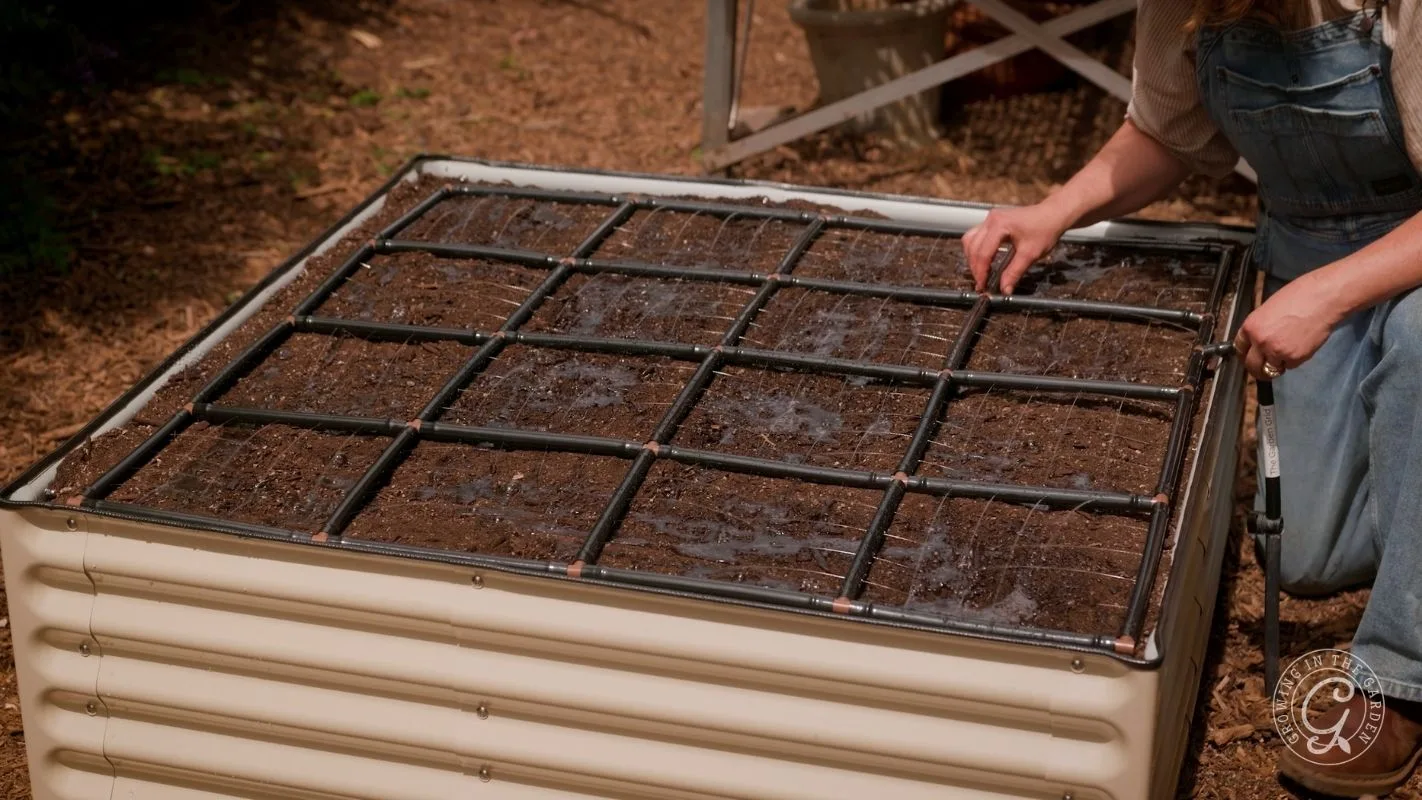
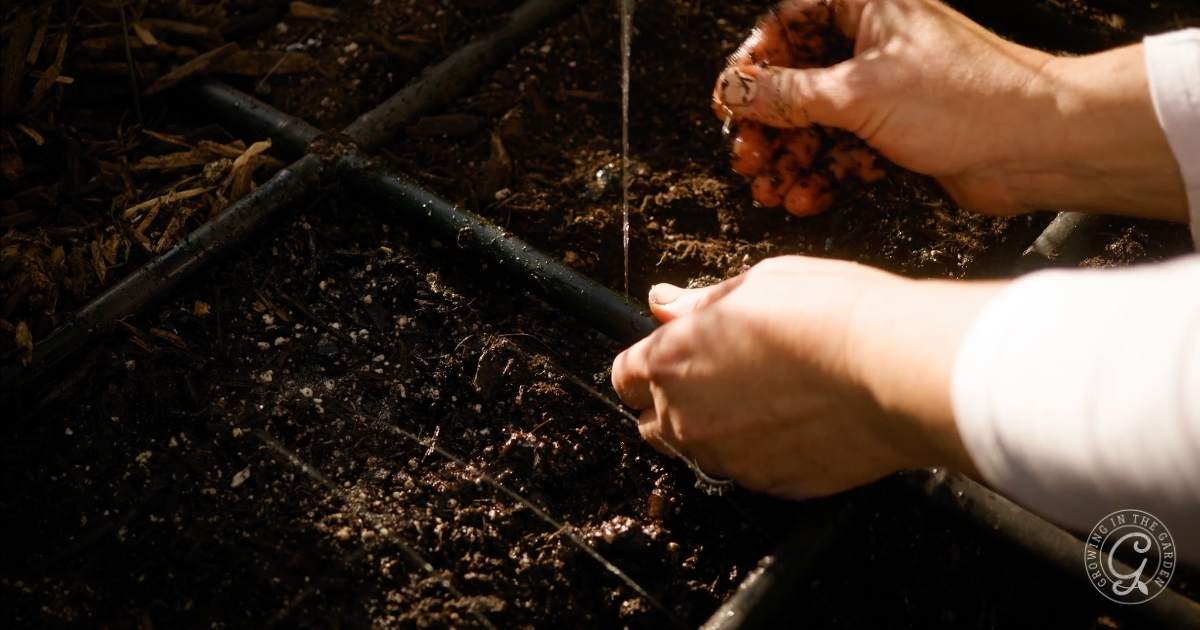
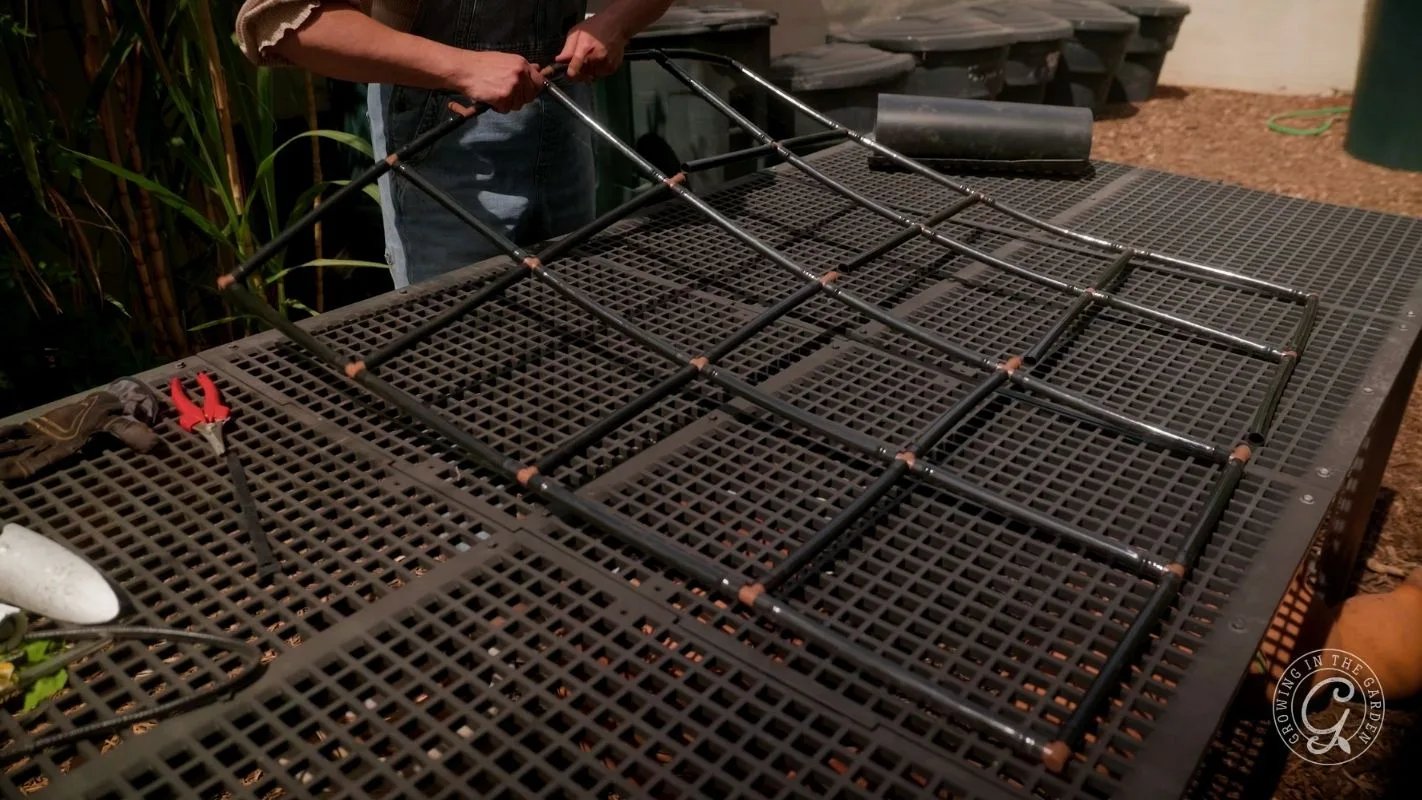
The design is simple: tubing laid out in a grid pattern with pre-drilled holes at regular intervals. When connected to a timer, it waters the entire bed evenly. There are no emitters to clog, and hard water deposits are easy to clear. At the beginning of each season, I check each hole to ensure it isn’t clogged by running my finger across any holes that are slowing down, and use a push pin to unclog them if needed.
I’ve added this garden watering system to every bed I’ve set up since 2017. Any new beds I add now include it from the start. My oldest ones, from 2017, still work well.
One detail that made a difference for me: I added a flow valve to each bed so I can adjust the water flow and pressure as needed. Garden In Minutes has flow valves and adaptor pieces on its website.
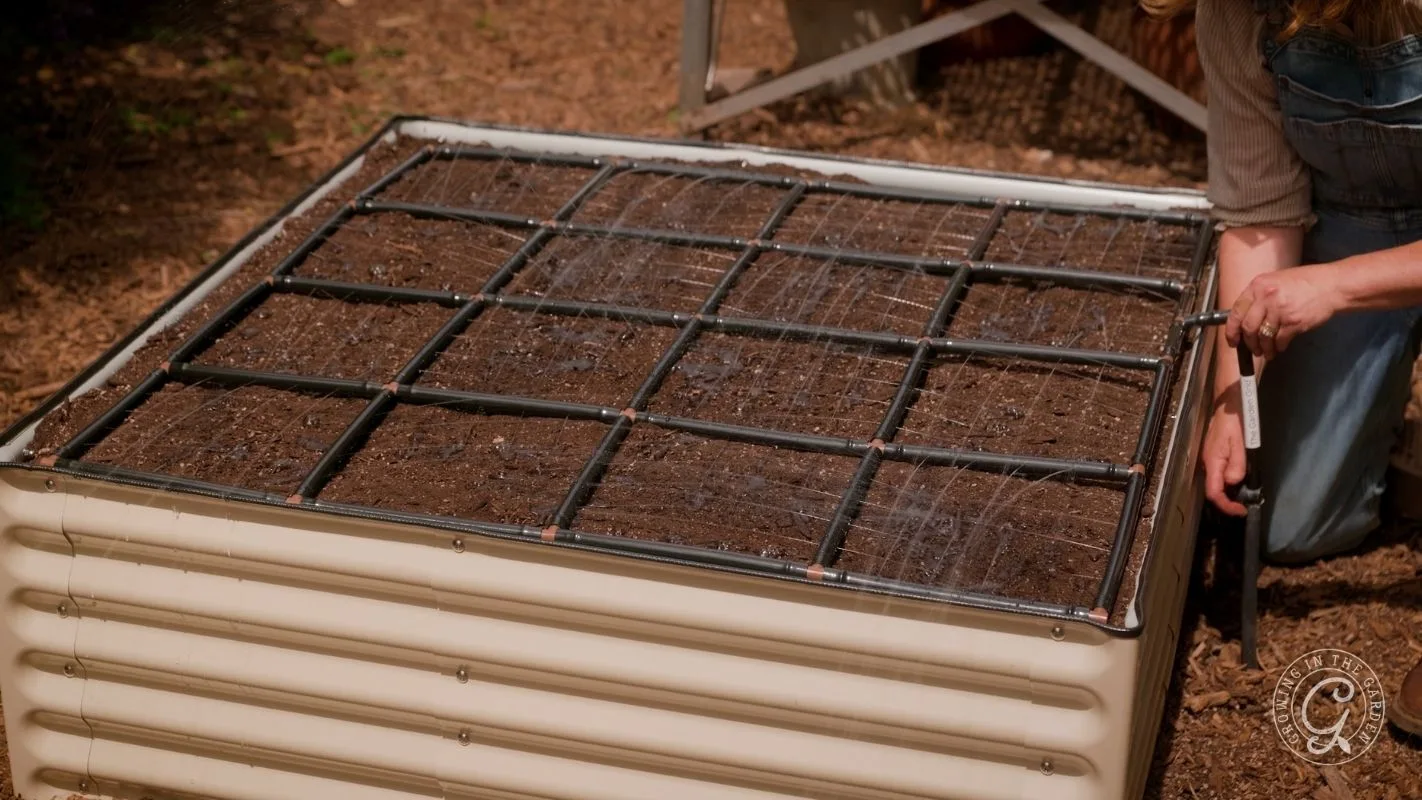
Shop the Garden Grid™ from Garden In Minutes: If you’re thinking about adding them to your garden, use code Angela10 to save $10 off $100 or ANGELA to save 7% on any size order.
How I Water My Beds in Arizona Throughout the Year
How Long I Water Each Time I Water
I run the garden watering system in the morning for about 12 minutes total, using a cycle/soak setup: 4 minutes on, 30-minute soak, 4 minutes on, repeat. That pause gives the water time to absorb into the soil rather than running off the surface.
How Often I Water Throughout the Year
Summer (May through September)
This is the hardest watering season. How often I water shifts quite a bit depending on the temperature — somewhere around every 3 to 4 days at the beginning of May, and as often as every day during a heat wave (prolonged temperatures above 110°F). Once we’re consistently at around 100°F, I usually water every other day. Checking the soil is crucial during this time. Learn more about how to water during a heatwave in this guide.
June is typically the driest month and requires the most water. When monsoon humidity arrives, plants may need a little less water, especially if we get rain, but the garden still requires regular watering. It’s crucial not to let the soil dry out completely.
Mulch is non-negotiable during summer. Without it, surface moisture disappears so fast that the top of the bed dries out between watering cycles, which affects seed germination and young seedlings especially.
Fall (October through November)
Transition time. I’m shifting back from more frequent watering to every 3 to 4 days, and then down to every 5 to 6 days by the end of November.
- October: I usually have a lot of new plantings going in at once, so I’ll water more frequently early in the month as plants get established, then back off as temperatures cool and roots grow deeper
- November: Usually every 5 to 6 days
Winter (December through February)
The slowest watering season. I water once a week or less, depending on temperature and whether we’ve had rain. Most established plants need very little at this point. I turn off the timer and check the soil before watering. It’s easy to overwater in winter when evaporation is slow and plants aren’t growing quickly.
Spring (March through April)
This is the mirror of fall: temperatures are climbing, and the garden is ramping up again, often with many new warm-season plantings going in.
- March: Still relatively cool, watering every 5 to 6 days, but starting to increase as days warm up
- April: Shifting back toward every 3 to 4 days as heat builds; new transplants and direct-sown seeds will need more frequent watering while they get established
- Watch for the jump — spring in the low desert moves fast, and the soil can start drying out noticeably faster within just a week or two
Germinating Seeds
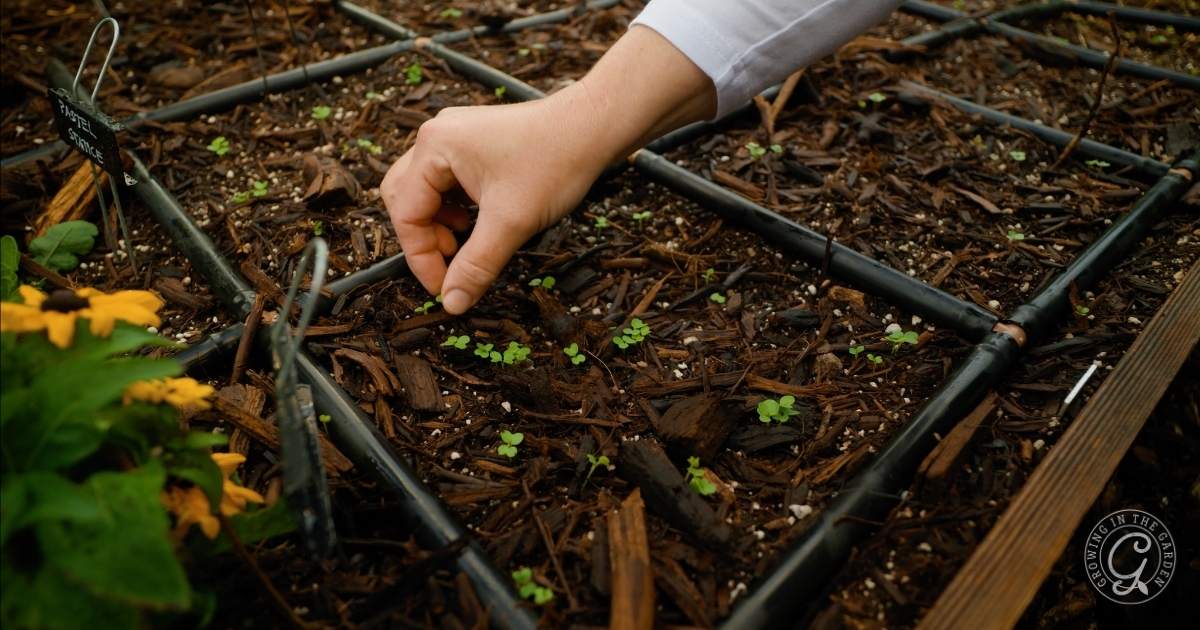
Newly planted seeds need the surface to stay consistently moist, which means more frequent watering, sometimes twice a day when temperatures are still warm. I usually hand-water those sections with a wand. Once seedlings are up and have their first set of true leaves, I start transitioning them to the regular drip schedule.
Connecting to Your Irrigation System
I run PVC to each bed and connect the Garden Grid™ to the 1/2 poly tubing. This keeps water pressure consistent even when several beds are running at once. If you’re connecting more than two or three grids, the PVC approach is worth considering. I did a video walking through exactly how I set this up. Garden In Minutes has adaptor pieces on its website.

Mulch Is Part of Your “Watering System”
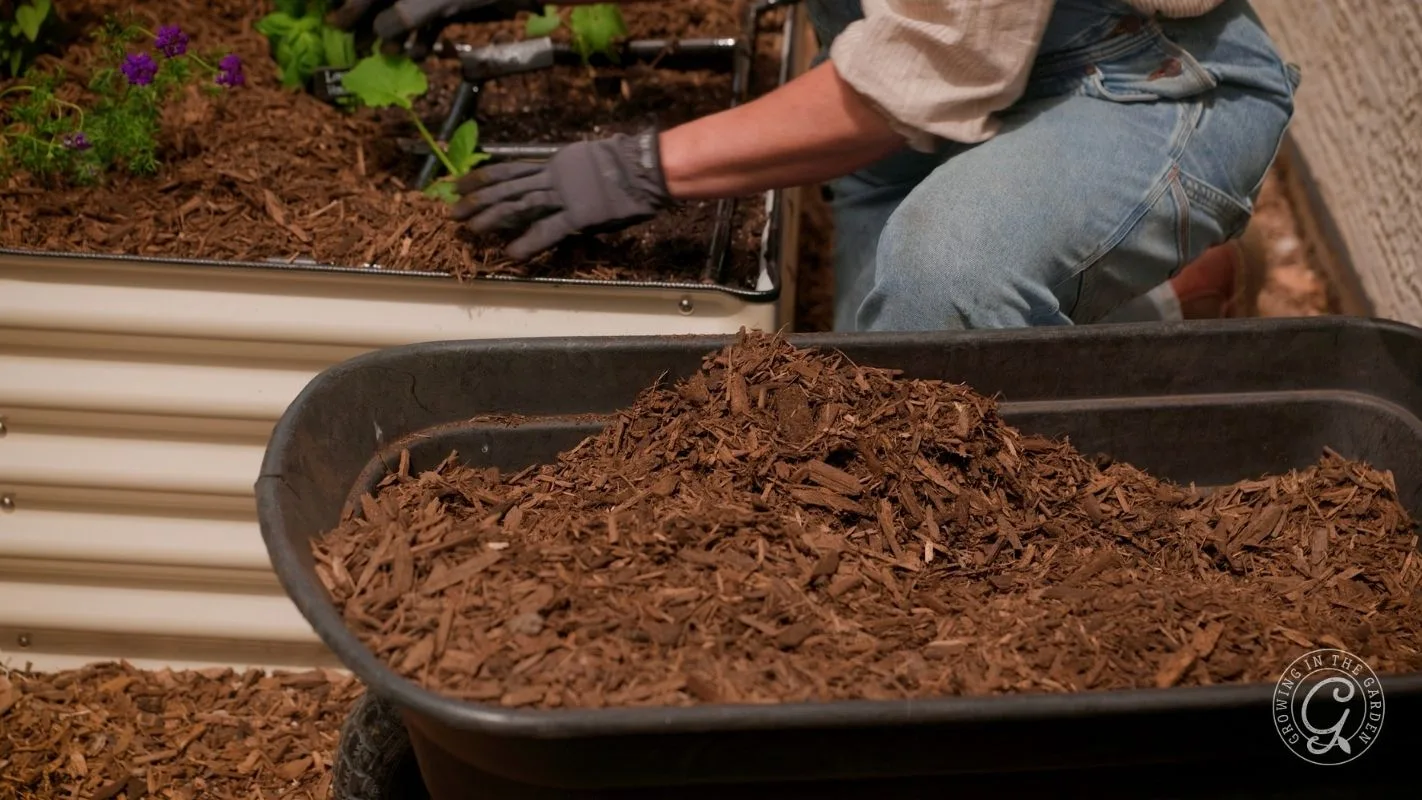
Mulch isn’t a nice extra. It’s part of managing water in a raised bed, especially in the desert. You can learn more in this guide: Water conservation tips for desert gardening
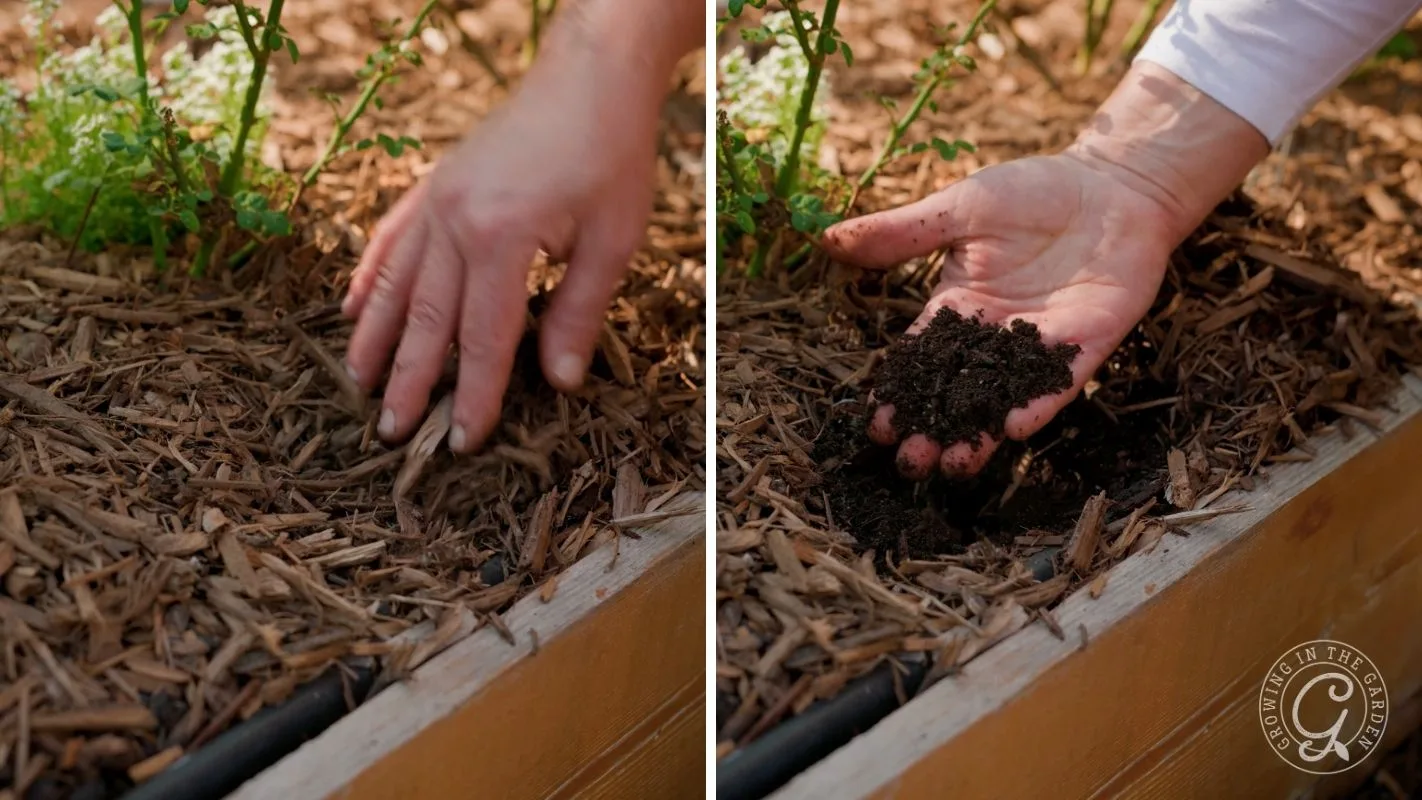
A 2- to 3-inch layer of mulch on top of the soil dramatically slows surface evaporation, keeps root zones cooler, and can noticeably cut your watering frequency. I’ve seen the difference in my own beds; a mulched bed holds moisture significantly longer than a bare one.
What I use: wood chip mulch, straw, or a combination depending on what I’m growing. I usually put the mulch on top of the watering grids. The Garden Grid™ works under straw and other mulches without any issues. Learn more about how to use mulch in this guide.
How to Know if You’re Watering Enough
Don’t rely on a schedule alone. Use these checks:
Finger test: Push your finger about 3 inches into the soil. If it feels damp, you’re fine. If it’s dry, water sooner.
Check at root depth: For established plants, what matters is whether moisture is getting down 8 to 12 inches. You can check this by watering, then digging a small test hole an hour later to see how far the water has penetrated. Spend time checking this and getting the timing right when you first set up a new watering schedule, and it’ll save you a lot of guessing. You usually only need to do this step once or twice when you are first determining how long to water each bed.
Watch the plants: Slight wilting in the morning is a warning sign. Wilting in the afternoon during peak heat is not necessarily. Many plants droop in extreme heat even when watered correctly. If they perk back up in the evening, they’re likely fine. Check the soil before watering.
Learn more here: When wilting means water more and when it does not
Troubleshooting
Your system is running, but the surface stays dry and crusty: This is hydrophobic soil. The water is beading off rather than absorbing. Here’s how to fix hydrophobic soil in the desert garden.
Plants are wilting, but the soil feels wet: Check for root rot. In summer, also consider whether the wilting is heat stress rather than a water issue; plants often droop in 110°F heat even when well-watered and recover in the evening.
Hard water clogging the grid holes: Rub the holes with your finger or a magic eraser for minor buildup. For stubborn clogs, a push pin clears them quickly. I’ve had grids for nearly a decade in Mesa’s hard water, and this is the only maintenance they’ve needed. I like to check the grids at the beginning of the spring and fall seasons and make sure they are working properly.
One bed dries out much faster than the rest: Check for invading tree roots. Nearby tree roots may be pulling moisture from the bed before your vegetables can use it. Installing a root barrier can help restore consistent soil moisture. Learn how to keep tree roots out of raised beds.
Bed location matters too. Raised beds in hot areas of your yard with less afternoon shade may need more frequent watering. Check the soil in each area of your garden. Learn more here: How to choose the best location for your raised bed garden
Shop the Garden Grid™ from Garden In Mintues: If you’re thinking about adding them to your garden, use code Angela10 to save $10 off $100 or ANGELA to save 7% on any size order.
Frequently Asked Questions
This depends on your water pressure, your bed size, and your soil. The goal is to water to a depth of about 12 inches. I recommend running your system, then checking how deep the moisture penetrated by digging a small test hole. Once you know how long it takes to reach that depth with your setup, you have a starting point. For me, with Garden Grid™ in Mesa, that’s usually 8 to 12 minutes total using cycle/soak.
In summer, daily or every other day. In the fall and winter, every 4-8 days, depending on the temperature. The best guide is always the soil — check it before you water.
Yes. I connected mine to my existing drip system using PVC. You’ll need to make sure your system has a garden hose adapter or can be plumbed to connect. I have a video walking through exactly how I did this. Garden In Minutes has adaptor pieces on its website.
Yes. Straw, wood chips, and other mulches work fine on top of or around the grid. Get more water-saving tips in this guide.
This garden watering system waters evenly enough for germination, but I recommend supplementing with hand watering for newly seeded sections, especially if you’re only planting part of a bed. A watering wand with a gentle setting is the easiest way to do this without disturbing seeds.
I use a flow valve on each bed to adjust the overall volume going in. Within a bed, I also plant lower-water herbs (like sage or oregano) near the corners or edges where the grid may give slightly less coverage. Plants with similar needs generally go together.
In my experience, yes. My oldest ones are from 2017 and still work. The tubing doesn’t degrade the way thinner drip line material does.
Yes. You can cut the tubing and add connector pieces to work around obstacles. I did this with arch trellises in my beds. When the grids arrive, they’re not fully assembled, so you can also route them before snapping the ends together.
Additional Resources
Ready to learn more about watering your garden? Join me for in-person gardening classes or online in my monthly Growing in the Garden Academy. I cover this and dozens of other timely gardening topics. Visit Patreon to start learning today, and don’t miss my class on Watering and Water Conservation.


Hi there,
Just wanted to let you know that Growing in Minutes is not honoring the Angela10 discount right now. They say expired.
Just FYI
Thanks. If items are already on sale, the code won’t stack.
How would these work with straw mulch? I have drip that I’m not thrilled with but at least it works under the straw. I live in a hot climate and my raised beds were drying out very quickly. Straw mulch was a game changer. Thanks for the video!
Hi – Yes these work under straw mulch.
Good morning! I live in Arizona and will be planting my garden today, October 3rd. How many minutes and how many days a week should I water using the garden grids? I will be planting a variety of seeds and potatoes. Thanks!
I wish I had an exact answer for you. You’ll need to monitor your soil moisture and adjust accordingly. You may have to water new and young seeds and seedlings more often. As plants become established (and especially as temps cool) you can water less often. Check your soil. For a reference right now I’m watering for about 12 minutes every 3 days. Best of luck with your garden!
Thank you for your great gardening guidance!
My question is about cleaning out the holes of the grid system. I’ve struggled with drip irrigation getting plugged up and planning to convert the garden watering system to the grid system. How do you prevent or clean out the holes of/when they get plugged up?
Thank you!
Usually I just rub the hard water deposits off. Using something like a magic eraser works well. For stubborn holes you can use a push pin. I’ve been amazed at how well these hold up. I still have the original one I began using in 2019 and it still works great!
The straw mulch seems to be impeding the growing grids’ from watering evenly, any solutions?
Your videos have convinced me to buy the Garden Grids, now just a few questions. I have 3’ x 6’ x 18” raised beds with excellent soil, how long should I water to be efficient and resourceful? Also approximately how long to start seeds? Any input would be greatly appreciated
Hi Robert. I think you’ll like the grids. Once they are set up you’ll have to run them and see how long it takes to water to a depth of about 12 inches. I use the cycle/soak setting on my system to make sure the water absorbs well. It may take a few tries for you to figure out how long to water. You should only have to do this one time. For seeds I also have a hose with a sprinkler attachment so I can hand water the areas with newly planted seeds without having to run the system for everything. Hopefully this helps. Happy to clarify more if you need me too.
I live here in Phx also and am wondering how often you are watering your beds? I’m struggling with how long I should water.
Right now I’m watering every other day for about 10 minutes. My watering grids water very fast however.
I live in tucson, on property with a well. Have you had problems with your garden grids getting clogged with hard water deposits over time?
This year I started noticing some of my older ones (4 years old) were getting clogged. I went around with a push pin and re did the holes that were clogged, that seemed to help. That’s the first time I’ve had to do that since owning them. How often you do would depend on your water.
How is the best way to connect the gardening grids to your main irrigation/sprinkler system? Right now all I have is a 3/4 in pipe which is already attached to its own dedicated zone to the area of where our gardening beds will be.
This video explains the process of how we did it: https://youtu.be/GXMsLnxkOEU
So im using a few IBC recycled totes to make raised beds with and im having a hard time figuring out how to connect 7 or 8 totes with walkways with an irrigation system without losing water pressure. How could I do that with this system?
Running PVC to each individual bed is what I had to do to maintain pressure with several grids: https://youtu.be/GXMsLnxkOEU
Have you tried self watering beds?
Yes. They were ok – I personally prefer traditional raised beds.
I am watering my seeds at 6am and 6 pm for 3min with the garden grid to ensue they stay moist. After a week I now have seedlings. Since I have seedlings now should I start lengthening my water for longer so the water goes deeper? Also I intend to plant more seeds every two weeks what do you suggest I do to keep them moist and not overwater the other plants? I have a 4×8 raised bed.
Yes as the seedlings get larger you can stretch out the time between watering and water more deeply. If you plant more seedlings I would use a hose to handwater them until they sprout.
Hi Angela, just started gardening and have been told not to use municipal water due to the amount of chlorine the city adds. What water source do you use?
I use city of Mesa water.
Mid August 2022 – I’m curious what your settings are for your raised beds this time of year. And what do you change it to in our valley Winters.
I’m North PHX w/ new 8’x2’ raised beds. Brand new inspired gardener here. Anyhow, I just installed drip tubing (1/4 .52 GPH). Using my Hydrawise timer, I have it set to 10 minutes every other day 5am. w/ cycle and soak. Is this a good starting point to experiment with. I’m looking for a safe ballpark.
Right now I’m watering every 2-3 days for about 10 minutes total (mine is “cycle and soak” as well) The grids I use water very quickly.
So far the best and most helpful site I have seen and been to! thank you!!!
Wow, thank you so much.
How do you protect zinnia leaves from rain if you shouldn’t get their leaves wet?
Of course, you can’t, but rainwater has less salt content than what we water our gardens with. If you get frequent rain, disease may be an issue for zinnias.
How do these do with minerals? Our water is a little harder than Colorado river water as it is well water. I use drip line with inline 1/2gph emitters and I pretty much replace them once a year because they get clogged up. I’ve had my eye on these for awhile but because of the price and unknown effect of the minerals (calcium?) I haven’t tried them. I’ve tried the calcium filters and they help a bit but not a great difference. It’s discouraging. Thank you!
Hi Jennifer, I haven’t had an issue so I reached out to Bryan at Garden in Minutes to answer your question. Here is his response: “Great question. Emitters are faster to clog with minerals and can’t really be cleared, it’s one of the main reasons we don’t use them. The holes for the water streams are closer to the size of a lawn sprinkler. While minerals can still build up, maintenance for the Garden Grid by minerals is very easy. You can rub up finger over any Garden Grid hole that has mineral build up to clean it off (similar to what you can do with a shower shower head), for faster maintenance you can run a brush over the tubing, and for very stubborn areas, inserting a safety pin will certainly clear the minerals. We have a quick video on Garden Grid care and maintenance here: https://gardeninminutes.com/easy-garden-grid-watering-system-care/
Just following up on my earlier question about the Garden Grids. I reached out to Garden in Minutes and they let me know that the Garden Grids can be ordered “cornerless” to fit into rounded planting beds. Problem solved. Can’t wait get get started.
Wonderful! Thank you for the update.
Hi Angela,
I noticed in one of your videos, the Garden grid watering system on a metal raised bed with rounded corners. The corners of the Garden grid were raised due to the rounded corners. Does this cause problems with the watering at the corners? I’m asking because I just purchased 3 Vego Raised Beds and I was planning to use the 4’x8′ configuration. I was also planning to buy 3 Garden Grids in the 4’x8′ size. Will this be OK or should buy the smaller Garden Grid size. We are new to raised bed gardening, so your advise is very much appreciated.
Dennis T.
Hi Dennis, I went out and took another look to be sure and I’ve liked the grid in that metal bed. The corners do overlap a bit, but it hasn’t been a huge issue. You could also reach out to the customer service at Garden in Minutes and tell them the type of bed you have and see what they recommend. They are very helpful. Hope that helps! Angela
I am going to install these garden irrigation grids but I have a question about your arched trellis….I want to have a butternut squash tunnel and need to install the trellis about 1 foot into each bed over the irrigation system. I see that your trellis is over the grids, too….are you having any trouble with the arch damaging the grids by being so heavy? Also, where did you get your trellis? Thanks!
Where the trellis went over the grids I snipped the tubing in half and added connector pieces after putting the trellis under the grids. I got the main arch trellises from twobrothersmetalworks.com and the trellises in this blogpost from Gardeners.com
What is the most effective way to water wooden wine barrels? Unsuccessfully tried 1/4″ drip soaker & emitter tubing this summer, turned into an absolute failure. Have had to hand water all 10 barrels daily to keep plants alive. Looks like a 2′ x 2′ Garden Grid might work nicely. What is your experience with watering your wooden barrels, & recommendations? BTW…love the channel. Am learning so much! JK.
My favorite way to water containers is with oyas. I use the large ones in wine barrels and it’s perfect. https://growinginthegarden.com/the-best-way-to-water-outdoor-potted-plants/
Hi Angela,‘I live in Phoenix also and have put in a complete new garden with 8+ raised beds. I love your website and all your incredible information for us desert gardeners. There are so few sights that really apply to our unique climate. So thank you!
I took your advice and used the garden in minutes garden grids for all of the beds and so far I’m living them. My question is, how long do you typically run them and how often, in the hottest part of the summer and also in the winter? When I first put them in I was doing for way too long, I think, since the water was running right through. Oh, I also used your raised garden Az Worm Farm compost mix to fill them all so it was very loose soil. I’m currently running them twice a day, 7 min in the evening and another 3 min in the morning around 6 am. Is that too much?
Thank you!
Hi Linda. I would try to water no more than once a day. Your watering times may differ depending on your water pressure. When it was less humid and 115 I was running them every day, but now that it’s in the low 100’s with humidity I’m running it every other day in the morning for about 8 minutes on most of the grids. I do have it on a cycle/soak setting so that it’s not 8 minutes all at once. It runs for 4 waits a bit and runs for another 4 minutes so it can absorb better. I also mulch the beds very well to help preserve the moisture.
Is this a system that’s easy to remove to till the beds soil?
I currently water by hand, there is an existing system hooked up to two beds but it doesn’t currently work. (new house, stuff was already here.) We added a couple beds but got carried away with tomatoes… So watering by hand takes a good hour or more. Cutting that down would be nice.
It’s simple to lift up and out (it’s still connected, but it is up on its side on the side of the bed). I don’t recommend tilling soil however, it’s better for the soil not to till.
I am ready to complete a large raised bed garden. It will use the square-foot system with 10 different crops in it. I doubt that I’ll have enough time for a drip or other system this year, so I was wondering how you feel about watering wands? They are not automatic, but cost less, take less time to set up, and I don’t need to re-configure them each season as we move the crops around (crop rotation).
I love watering wands. That’s my preferred way to hand water. It can take a while to do it by hand but they are effective.
Angela, Thank for your informative video on how to connect the grid to your own drip system. I am a visual learner and the video helped, At Garden in Minutes site the FAQ”s : “if you want to feed water to your Garden Grid from your sprinkler system or existing irrigation you can too. You will just need to ensure your system has a garden hose adaptor”
How did you connect from your original main line of your drip system before feeding to each raised bed with the grid? Did you use a garden hose connector? Also when finishing it looks like you leave their white connectors on. I feel like I should understand all, but I am really a novice of setting up drip.
I had help from a friend who helps me with sprinkler repairs and installations. You have to connect the PVC to the dripline. If you are trying to connect it to your main watering system (not a hose) you may want to get help from a professional.
How do you handle different watering needs for different plants in the same bed/grid? Or do you only plant varieties with the same needs together? Sometimes companion planting may not be conducive to that though.
Good question. I typically water the beds deeply each time I water and the plants all get the same amount of water. There are areas in the beds that get less water (sometimes on the corners) if the grids don’t go all the way to the edge. I plant lower water use herbs (like sage) in those areas. I do have a valve on each bed that controls the amount of water each bed gets so I plant lower water use / or higher use plants together.
I’m using grow bags (16 and counting!) on a timed drip system, but it’s challenging to meet the watering different needs of every plant. I just started gardening in February and your website has been a God-send – thank you very much!!!
One more question: when you a liquid fertilizer such as fish emulsion, how do you work that into your watering schedule? Do you do it manually and skip a programmed watering so you don’t overwater? Apply it first and then reduce the timed amount?
When you fertilize it’s best to water well before, so the plants get extra water when I fertilize.
Do the garden grids come completely apart? I want to retrofit around mature tomato plants. Will this work? TIA!
I retro fitted mine around trellises by cutting through the tubing and using connectors. You could try that. When they come in the mail they are not completely assembled, you may be able to put them around the plant before you push the ends together.
Thanks so much for your post! How long have you had the Garden Grids? Have they had any issues? I have drip irrigation in my raised beds, and I’m thinking about using the garden grids in my new raised beds for improved water coverage. I’m not sure they will be worth the investment though if they don’t hold up to our desert sun. 🙂
I got my first grids about 4 years ago and have added them slowly since that time. I haven’t had any issues with them deteriorating.
I like the helpful info you supply for your articles. Thanks for sharing a smart thought.
Raised bed built land filled but now the soaker hose seems to provide too much water…runs out almost as soon as it’s turned on. Upset wire reinforced with narrow boards… cardboard before soil added. What to do.
You could try to reduce the water pressure so the water comes out more slowly and can penetrate the soil rather than running out.
Is it made from 1/2 inch tubing or micro tubing? Hard to tell from pics. Also, how small are the holes? With all the holes spraying at once it would seem like you would lose water pressure. Thanks!
It is made from 1/2 tubing. The holes for water are very small. Losing water pressure hasn’t been a problem the way I have them set up in the garden, usually no more than 2-3 grids connected at one time.
Did you buy two 4×4’s and place them together, I have the same beds as you do.
I ordered 4×8 grids, if they aren’t listed on the website, I would email them and ask about ordering that size.
What raised 4×8 bed do you have or did you build it from scratch?
I use the deep root cedar bed from Gardeners https://www.gardeners.com/buy/deep-root-cedar-raised-beds-4ft/8609751.html